Der taiwanische Anbieter Airiti hat bis zum 30.06.2024 einen Testzugang für erweiterte Bibliometriefunktionen auf den bekannten Portalen (TEPS, CETD, …) der airitilibrary.com Plattform eingerichtet. Diese ermöglichen Rechercheoptionen auf Grundlage von Zitationsindexen sowie Keywords der Volltexte, die auch im Batchexport zur Verfügung stehen. Der Zugrunde liegende Academic Citation Index kann über ein eigenes Portal direkt aufgerufen […]
Der Beitrag Testzugang Airiti „Results Analysis Module“ bis zum 30.06.2024 erschien zuerst auf CrossAsia.
Der Lyriker erhält für „Zabriskie“ den Preis für den besten niederländischsprachigen Gedichtband des vergangenen Jahres.
Weiterlesen
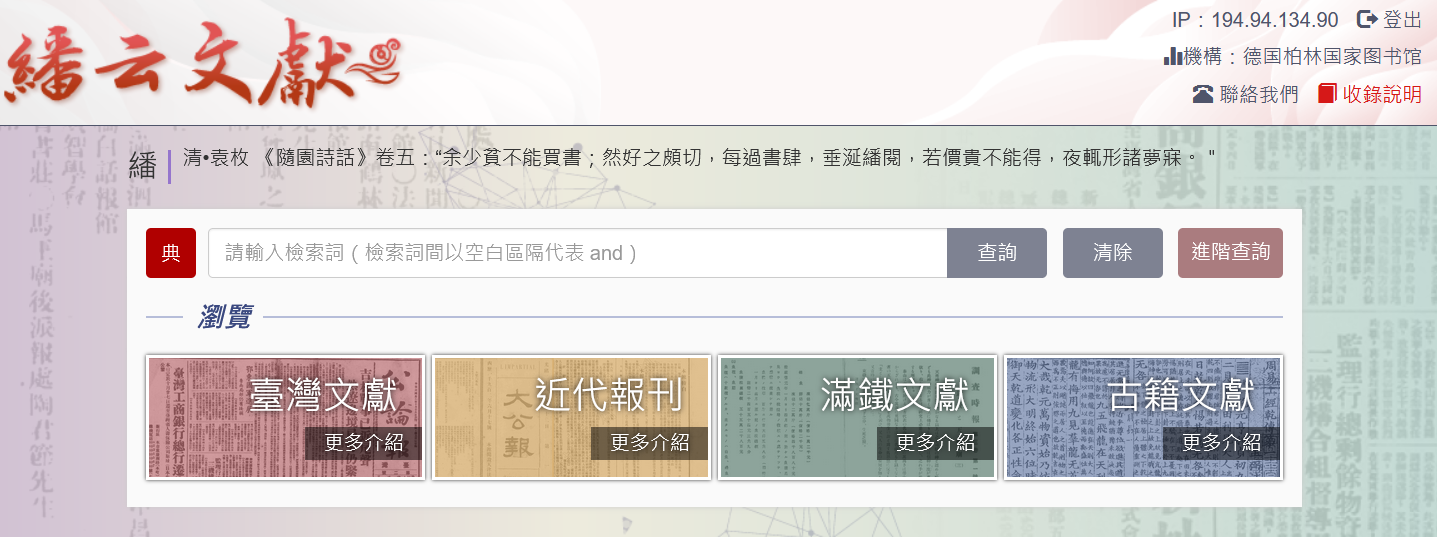 Das uns allen als Diaolong bekannte Portal für historische chinesische Quellentexte hat sich eine übergeordnete Webseite zugelegt: Fanyun (zum Öffnen klicken). Im Testzugriff bis zum 15. Juli 2024 sind dort für CrossAsia- und Stabi-Nutzer:innen alle Ressourcen aus den Blöcken taiwanische Materialien/Zeitungen vom Anfang des 20. Jahrhundert bis in die 1960er Jahre und Dokumente zu Mantesu […]
Der Beitrag Testzugang für taiwanische Zeitungen (1905-1965) und Mantetsu 滿鉄 Materialien (bis 15. Juli 2024) erschien zuerst auf CrossAsia.
Am 15.04.2024 haben die UB der HU Berlin und das Forschungsdatenzentrum Qualiservice an der Universität Bremen gemeinsam den Antrag für die mittlerweile vierte Förderperiode 2025-2027 für den Fachinformationsdienst Sozial- und Kulturanthropologie (FID ...
Mitte April haben wir unseren Webauftritt neu gestaltet. Die Nutzer:innen des FID werden es längst bemerkt haben: sowohl die Portalseiten, als auch das Discovery (unser Suchsystem), sowie das Romanistik-Blog haben ein Redesign erfahren. Im Hintergrund wurden aber nicht nur Farben, Formen und Texte angepasst, sondern auch die Software auf neueste Versionen geupdatet. Unser Discovery basiert …
„Relaunch des FID Romanistik: Neugestaltung von Portal, Discovery und Blog“ weiterlesen
 Im Sommersemester 2024 bietet das Team von CrossAsia wieder zahlreiche Online-Schulungen zu den hauseigenen Angeboten an. Neben allgemeinen Einführungsveranstaltungen zu CrossAsia werden auch spezielle Veranstaltungen zu den einzelnen Regionen (China, Japan, Korea, Südostasien und Zentralasien) sowie zu einzelnen Materialtypen angeboten. Das aktuelle Programm finden Sie wie immer im CrossAsia Classroom und unter der Rubrik „Workshops […]
Der Beitrag CrossAsia Classroom: Online-Seminare im Sommersemester 2024 | CrossAsia Classroom: online seminars in the summer semester 2024 erschien zuerst auf CrossAsia.
Mit Kriminalistik und Künstlicher Intelligenz auf den Spuren von Lope de Vega? Im Vorfeld des Día del libro (Welttag des Buches am 23. April) geht ein faszinierender Bericht von RTVE auf neueste Forschungsmethoden in Spanien ein, mit denen das Werk von Lope de Vega untersucht wird. Polizeiliche Techniken wie die Spektralfotografie oder die künstliche Intelligenz …
„Kriminalistik und KI: Was bleibt von Lope de Vega?“ weiterlesen
Wordsworth, John. The national Church of Sweden. London 1911.
Melsted, Henning Finne von. Folket i fångenskap. Stockholm 1916.
Vom 06.03. bis zum 08.03.2024 fand das diesjährige DPhG – International PhD Student & Postdoc Meeting 2024 bei CSL-Behring in Marburg statt. Im Rahmen dieses Treffens präsentierten wir PubPharm und seine speziellen Recherche-Tools: Mit den Drug Overviews lassen sich Informationen zu gesuchten Wirkstoffen, darunter Angaben zum Indikationsgebiet, zur Arzneiform und zu Targets, aus der aktuellen […]